
The Irish Business Central localisation landscape is changing

Wednesday, July 15, 2026
Reading time: 4 minutes

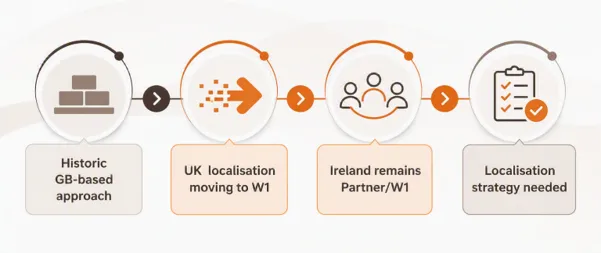
For many Business Central Partners working with Irish Customers, localisation has historically been a practical delivery question: how do you make Business Central fit Irish VAT, reporting, document, and address requirements in a way that is maintainable for the Customer? In many cases, this has meant extending GB-based approaches or adding Partner-developed functionality to bridge the gap for Ireland. Based on Companial’s Partner research, this is exactly why the current platform shift matters: the foundation many Irish implementations may have relied on is changing.

Microsoft is moving the UK localisation towards a W1-based model, where local functionality is delivered as a set of extensions on top of the W1 Base App. Microsoft’s public release information describes this as part of removing country-based customisations from the base app, with benefits including lower implementation cost, easier multi-region operation, improved handling of per-tenant extensions, and broader ISV access.

For Ireland, this change is especially relevant. Microsoft’s public country and regional availability information lists Ireland as a Partner-localised, W1-based Business Central country/region. Ireland is also not listed among the countries where Microsoft provides Microsoft-led local functionality. In practical terms, this means Ireland should be understood as a W1 + Partner localisation market, not as a Microsoft first-party localised country.

This does not mean Partners should panic. It does mean Partners should start reviewing how their Irish Customer environments are currently structured, especially where implementations have historically followed GB-based assumptions. The safer and more future-oriented question is not simply whether an Irish Customer is working today, but whether the Customer’s localisation approach remains aligned with Microsoft’s direction for Business Central going forward.

 

Why the timing matters

The transition is time-bound. Microsoft states that from Business Central 2025 release wave 2 / version 27, the UK localisation works as extensions on top of the W1 Base App. Microsoft also states that users can choose whether to enable the new features for the next three releases, after which previous features are deprecated and the new localisation is automatically enabled. Based on the regular major release rhythm, this points to April 2027 as the practical planning horizon for Partners reviewing GB-related dependencies.

That timeline creates a clear planning window. Partners do not need to solve every Irish Customer scenario immediately, but they should begin identifying which Customers may be affected, which customisations depend on GB-specific assumptions, and which future projects should be aligned to the W1 + localisation app model from the start.

Why Ireland needs a localisation strategy

Irish localisation is not only about user preference or terminology. Irish businesses have practical compliance and operational requirements that need to be reflected in their ERP setup. Revenue guidance covers areas such as VAT3 reporting, VAT invoice information, reverse-charge treatment, VAT records, and auditability. Irish address handling also has local conventions, including Eircode and county usage.

For Partners, this makes localisation a delivery and Customer-success topic. Customers need a Business Central setup that supports local operations, reporting expectations, and maintainability over time. If that setup is based on Customer-specific workarounds or historical GB-based assumptions, now is the right moment to review whether that approach remains the best long-term option.

The direction: W1 + localisation apps

Microsoft’s documented model for countries where it does not deliver localisation is that Partners can build localisation apps for the Marketplace on top of W1. This matters because it gives Partners a clearer architectural direction: keep the foundation aligned with W1 and deliver country-specific requirements through localisation apps rather than relying on country-customised base app assumptions.

For Ireland, this is where Localization for Ireland becomes relevant. Localization for Ireland is Companial’s Partner-focused solution for Business Central online Customers operating in Ireland. It is intended to support Irish localisation requirements in a way that aligns with the W1-based direction and gives Partners a practical path for Irish deployments.

The goal is not simply to introduce another app. The goal is to help Partners respond to a structural change in the Business Central landscape and give Irish Customers a more sustainable localisation path.

What Partners should do now

Partners working with Irish Customers should begin with a simple readiness review:

  1. Identify existing Irish Business Central Customers.
  2. Review whether those environments contain GB-specific assumptions, extensions, or customisations.
  3. Check whether upcoming Irish opportunities are being designed on a W1-aligned basis.
  4. Consider where a standardised localisation app could reduce long-term maintenance and upgrade risk.
  5. Start Customer conversations early, using planning and evidence-based guidance rather than deadline-driven pressure.

The important message is not alarm, but preparation. The Irish Business Central localisation landscape is changing, and Partners who review their Customer base now will be better positioned to advise Customers, plan upgrades, and pursue new Irish opportunities with confidence.

In the next article, we will look at Microsoft’s Validated Localization programme and why it matters for Ireland.

Review your Irish Customer portfolio and current localisation approach.

Identify Customers or projects that may rely on GB-based assumptions and start assessing whether a W1-aligned localisation path should be considered.

Ready to take the step and explore Companial Irish Localisation, book an online call

Jonas Cirtautas

More about Business Central